| (Download)
The second meeting of the Harmonium Friends, organized by Joachim
Weischet and Ulrich Averesch, was held in Borna, Germany on May 8, 9 and 10, 1998. The
meeting was hosted by Joachim and Christa Weischet in the Lindholm factory. Mr. Averesch
served as moderator. A total of about fifty people attended, mostly from Germany but
several from The Netherlands, Switzerland, Yugoslavia and the United States.
Borna was once a major center of reed organ manufacture in Germany.
Urban Kreutzbach, the pipe organ builder, hired Theodor Mannborg, Olof Lindholm and Magnus
Hofberg from Sweden in 1886 to work in his factory in Borna. Three years later Mannborg
established his own factory in Borna to make reed organs, taking Lindholm and Hofberg with
him. Hofberg left and organized his own factory in in Leipzig in 1891. In 1894 Mannborg
moved his factory to Leipzig. Lindholm remained in Borna and founded his own factory.
Lindholm sold his factory to Gustav Weischet, the grandfather of Joachim, in 1911 and
retired. This factory is presently used for the manufacture of harpsichords and for a reed
organ museum by Joachim Weischet and his son.
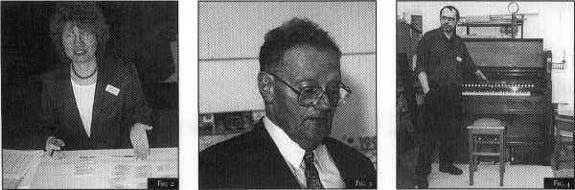
The activities began in the morning of Friday, May 8 with a warm
welcome from Joachim Weischet. [Fig. 3] Ulrich Averesch followed with a discussion of the
harmonium in today’s world. [Fig. 4] The afternoon sessions began with an interesting
presentation of the "Harmonium-Plus," a hybrid harmonium instrument, by
Professor Christian Ahrens of the University of Bochum, Germany. Professor Ahrens is the
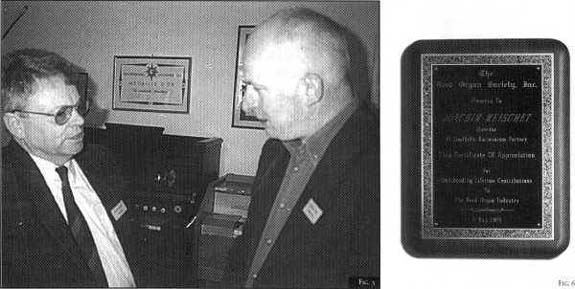
coauthor with Gregor Klinke of "Das Harmonium in Deutschland." [Fig. 5] I
followed with a discussion of the development of the reed organ industry in the United
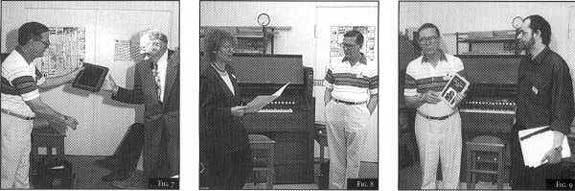
States.[ Figs 6,7] On behalf of the Reed Organ Society I presented a certificate of
appreciation to Mr. Weischet together with a covering letter from Mrs. Agnes Armstrong,
President of the Society. [Figs. 8, 9] The day before leaving Florida for the meeting I
received the first copy of the second edition of "Gellerman’s International Reed
Organ Atlas." This copy was presented to Ulrich Averesch in recognition of his
efforts in organizing the meeting.
The highlight of the first day’s activities was a brilliant
concert on the Lindholm Art-harmonium played by Johannes Matthias Michel. Mr. Michel is
well-known as a recording artist on the pipe organ, and is a church organist and music
director in Eberbach, Germany. The program included selections from Karg-Elert and Wagner.
The harmonium is the same instrument used by Sigfrid Karg-Elert for a concert in Borna in
1928.
Frau Engelmann of the Borna city archives began the second
day’s presentations with a thoroughly researched history of the origins of harmonium
manufacturing in Borna. This was followed by a discussion of the manufacture and sales of
harmoniums by Joachim Weischet. Mr. Weischet is one of the few remaining people in the
world today who was personally engaged in the manufacture of reed organs. Most of the
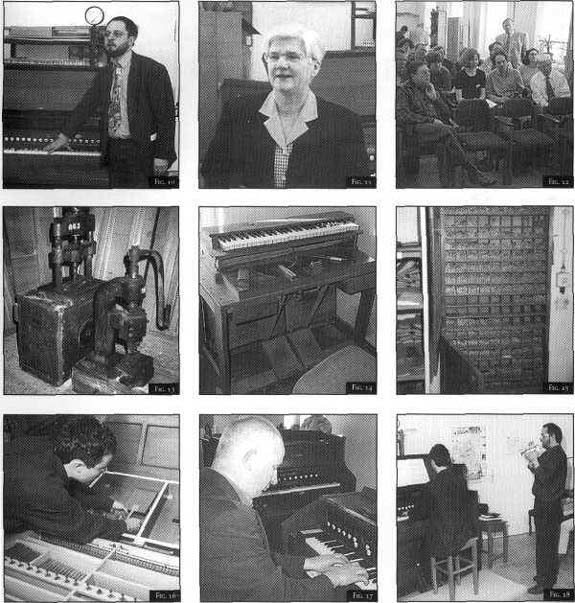
afternoon was devoted to a business meeting of the Harmonium Friends. [Fig. 12]
I took advantage of this time to prowl the factory. Borna is located
in the former East Germany. Mr. Weischet operated the factory as a private business well
into the time of the German Democratic Republic, but ideology eventually prevailed and the
government confiscated the factory. The machinery was removed and the building boarded up.
After the collapse of the GDR, Mr. Weischet was able to recover ownership of the factory
building. While almost all of the machinery had been removed, a few pieces remained and
are kept as a display in the museum portion of the building. [Figs. 13, 14] Oddly enough a
large quantity of reeds and several tons of brass also remained. Mr. Weischet recently
donated the brass to the recycling program. [Fig. 15] At the conclusion of the meeting,
Mr. Weischet presented a new bass reed to each attendee as a souvenir.
[Fig. 16]
The grand finale of the formal part of the meeting was another
wonderful concert, this time played by Mark Richli of Zurich, Switzerland. He played
selections by Alexander Guilmant and Sigfrid Karg Elert on the Lindholm Art-harmonium.
On Sunday, May 10, many of the attendees travelled to nearby Leipzig
for a visit to the organ collection at the Music Instrument Museum of the University of
Leipzig. Klaus Gernhardt, chief of restoration at the museum, described and demonstrated
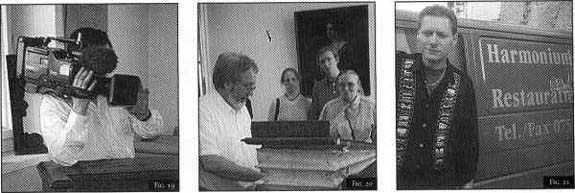
the historic instruments in the collection. [Figs. 20, 21]
_____________________
Photographic credits: Stefan Gruschka: Figs. 3, 4, 7, 9, 10, 11, 16,
18. Others by Gudrun Kreft & Robert Gellerman.
[CAPTIONS]
[Fig. 1] Program of the Second Meeting of the Harmonium Friends in
Borna.
[Fig. 2] Gudrun Kreft Averesch at the registration desk.
[Fig. 3] Joachim Weischet opened the meeting.
[Fig. 4] Ulrich Averesch discusses the harmonium in today’s
world.
[Fig. 5] Professor Christian Ahrens presents the
"Harmonium-Plus."
[Fig. 6] Certificate of appreciation from the Reed Organ Society to
Mr. Weischet.
[Fig. 7] Fritz Gellerman presents ROS cerftificate to Joachim
Weischet.
[Fig. 8] Gudrun Averesch reading the letter from ROS President Agnes
Armstrong to Mr. Weischet.
[Fig. 9] Fritz Gellerman presents copy number 1 of the new Reed
Organ Atlas to Ullie Averesch.
[Fig. 10] Johannes Michel discusses the capabilities of the Lindholm
art harmonium prior to his concert.
[Fig. 11] Frau Engelmann discusses the history of reed organ
manufacturing in Borna.
[Fig. 12] The attendees pay close attention to one of the
presentations.
[Fig. 13] Some of the reed-making machinery in the Lindholm factory.
[Fig. 14] A reed tuning and voicing jack in the Lindholm factory.
[Fig. 15] Some of the remaining stock of new reeds in the Lindholm
factory.
[Fig. 16] Mark Richli makes last minute adjustments to the double
expression mechanism of the Lindholm art harmonium.
[Fig. 17] During one of the coffee breaks, Maartin Stolke tries out
on of the harmoniums in the Lindholm museum.
[Fig. 18] An impromptu musical interlude with Mark Richli on the
harmonium and Ullie Averesch on trumpet.
[Fig. 19] The meeting was covered by public television and the local
newspapers.
[Fig. 20] Klaus Gernhardt, chief of restoration at the the Music
Instrument Museum of the University of Leipzig describes one of the instruments while
Christa Weischet and others look on.
[Fig. 21] Louis Huivenaar came from the Netherlands in this
beautifully decorated van.
|
 Mechanical
Music Digest™
Mechanical
Music Digest™ 


 Gellerman