Pittsfield, Massachusetts
data courtesy Bob & Ginny Billings
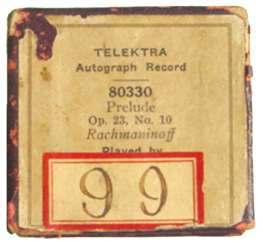
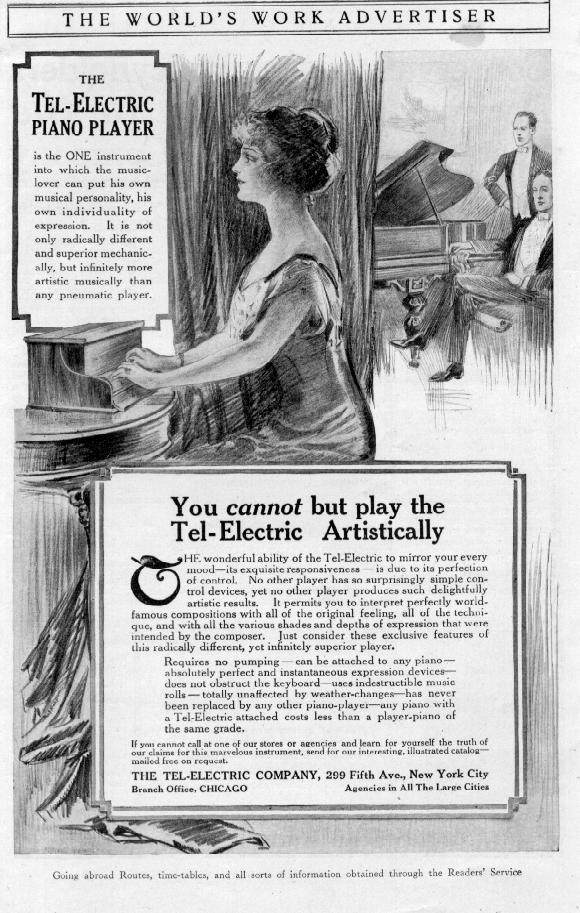
Between 1907 and 1918 the Tel-Electric Company made two different all-electric
piano player systems. The earlier 65-note system originally was called
the
"Tel-Electric Piano Player", but the system's brand name was later
changed to "Telelectric". The 88-note system, introduced in 1913,
was called the "Telektra."
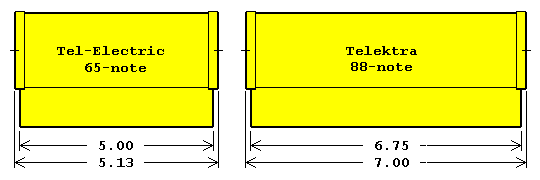
The music rolls for both systems were designed originally to play a note sheet of brass, 3 thousandths inch thick (.003"). The roll of perforated brass sheeting was enclosed in a sturdy brass cylinder: the 65-note rolls played by the Telelectric (Tel-Electric) system were encased in a cylinder 5-1/8 inch long, whereas the 88-note brass rolls for the Telektra system were in a case 7 inches long. The roll number is usually stamped on the first half-inch of the roll or on the end of the roll case.
Sometime in the mid 'teens the 88-note "Telektra" system was redesigned to play music rolls of heavy, stiff paper, probably due to the brass shortage during WW1. The rolls look something like miniature standard paper 88-note rolls: the heavy paper is spooled on cardboard cores and the spool flanges are small diameter conventional 88-note flanges with the normal slot at the driving end.
A history of the Tel-Electric Company, including about 450 pages of
a catalog of the music rolls produced by Tel-Electric Co. between 1905
and 1917 (about 6,000 titles), is published in volume 6 of The
Billings Rollography.
18 May 2004