Greetings -- In 2020 I posted a video of a real-time music book
player just to demonstrate the ability to use phototransistors
to capture the holes in a music roll or book:
https://youtu.be/7JFtLZ3Js4M
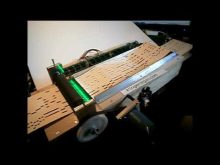 The microphone on the camera picked up the stepper motor more than
the speakers that were sitting on a shelf nearby. In the video, the
music book is made of file folder stock and is 5-1/2" wide. The
spacing on these books is for the John Smith 20-note tracker scale
with the first three notes being 9mm apart and the rest 6mm apart.
Unused notes on the capture board are ignored.
Because most of the work I have been doing is with organs or other
instruments that only use MIDI note ON and MIDI note OFF, there is
no adjustment for velocity or other special effects on the capture
boards. Because I used the term 'MIDIcap' to label the boards, they
are referred to as MIDI capture boards. The term MIDI encoder is also
used for this function.
The input to the MIDI capture boards is 'pull [connect] to ground'.
The input pins are held high (to 5-volts DC) with a 10K resistor
on the board. Most of the phototransistors I have been working with
"pull" to ground when the light source is on. For older organ relays
where the key contacts are supplying a 12v DC positive, I have
voltage dropping and inverting circuit boards available. For the
phototransistors, no additional hardware is necessary.
The output signal of the MIDI capture boards is a standard 5-pin
MIDI socket. The boards can be built up to 128 outputs. The outputs
can be programmed to accept any note on any channel. If more than
128 notes are needed the output of the boards can be merged with
a MIDI merger box. There are many MIDI editor programs available
that are capable of recording one or multiple channels of input.
After making up the 20-note John Smith style board sets, I made up
board sets for Gavioli, Ruth, Wurlitzer 125, 150, 165 (also APP),
100-position 9-to-the-inch and Aeolian staggered 12-to-the-inch
spacing. These are offered for sale.
The phototransistors and light emitters are surface mount components.
This allows for low profile and compact spacing. At the time I made
the boards, through-hole components were not available that were
thin enough to set them side by side as close as is necessary for
the 9 holes-to-the-inch spacing. Recently Shugan in China started
producing IR LEDs and matching phototransistors that allow this close
spacing. Where necessary, 3D-printed masking cells confine the light.
Initially, the phototransistor boards were individually wired from
the board to the MIDIcap board. In later revisions, JST-PH sockets
were added to the phototransistor boards design. Other options could
be ribbon cable headers or any other type of connector necessary.
The MIDIcap boards have screw terminals but that too could be any
number of commercially available connectors.
I do not have a lot of information on the phototransistor/LED boards
on my website: http://klingerorgan.com/ but I welcome inquiries and
can supply more information and photos as needed.
Christian Blanchard in France has been working with Phil Dayson on
encoder boards more specific for piano roll scanning. His website
is https://orgautomatech.fr/
Bill Klinger - Klinger Organ
Flippin, Arkansas, USA
tel.: 1-870-453-7503
billk65@gmail.com.geentroep [delete ".geentroep" to reply]
The microphone on the camera picked up the stepper motor more than
the speakers that were sitting on a shelf nearby. In the video, the
music book is made of file folder stock and is 5-1/2" wide. The
spacing on these books is for the John Smith 20-note tracker scale
with the first three notes being 9mm apart and the rest 6mm apart.
Unused notes on the capture board are ignored.
Because most of the work I have been doing is with organs or other
instruments that only use MIDI note ON and MIDI note OFF, there is
no adjustment for velocity or other special effects on the capture
boards. Because I used the term 'MIDIcap' to label the boards, they
are referred to as MIDI capture boards. The term MIDI encoder is also
used for this function.
The input to the MIDI capture boards is 'pull [connect] to ground'.
The input pins are held high (to 5-volts DC) with a 10K resistor
on the board. Most of the phototransistors I have been working with
"pull" to ground when the light source is on. For older organ relays
where the key contacts are supplying a 12v DC positive, I have
voltage dropping and inverting circuit boards available. For the
phototransistors, no additional hardware is necessary.
The output signal of the MIDI capture boards is a standard 5-pin
MIDI socket. The boards can be built up to 128 outputs. The outputs
can be programmed to accept any note on any channel. If more than
128 notes are needed the output of the boards can be merged with
a MIDI merger box. There are many MIDI editor programs available
that are capable of recording one or multiple channels of input.
After making up the 20-note John Smith style board sets, I made up
board sets for Gavioli, Ruth, Wurlitzer 125, 150, 165 (also APP),
100-position 9-to-the-inch and Aeolian staggered 12-to-the-inch
spacing. These are offered for sale.
The phototransistors and light emitters are surface mount components.
This allows for low profile and compact spacing. At the time I made
the boards, through-hole components were not available that were
thin enough to set them side by side as close as is necessary for
the 9 holes-to-the-inch spacing. Recently Shugan in China started
producing IR LEDs and matching phototransistors that allow this close
spacing. Where necessary, 3D-printed masking cells confine the light.
Initially, the phototransistor boards were individually wired from
the board to the MIDIcap board. In later revisions, JST-PH sockets
were added to the phototransistor boards design. Other options could
be ribbon cable headers or any other type of connector necessary.
The MIDIcap boards have screw terminals but that too could be any
number of commercially available connectors.
I do not have a lot of information on the phototransistor/LED boards
on my website: http://klingerorgan.com/ but I welcome inquiries and
can supply more information and photos as needed.
Christian Blanchard in France has been working with Phil Dayson on
encoder boards more specific for piano roll scanning. His website
is https://orgautomatech.fr/
Bill Klinger - Klinger Organ
Flippin, Arkansas, USA
tel.: 1-870-453-7503
billk65@gmail.com.geentroep [delete ".geentroep" to reply]
|