at Mechanical Music Digest
This site is a collection and remembrance of the people, both the living and the long-departed, who contributed or are contributing to the Automatic Music industry and its musical pleasure. Some rogues and villains appear here, too! Names marked with the asterisk (*) have been selected by MMDigest for special recognition because of their significant impact upon the industry.
Please contact MMDigest if you can help write short biographies of these people.
During the Heyday:
Industrialists & Marketeers
*Edwin Welte
*Farny Wurlitzer
J.
P. Seeburg
Ignatz Blasius Bruder (Waldkirch
Organ Industry)
Ludwig Hupfeld
Hugo Popper (Welte-Mignon)
? (Aeolian Piano Co.)
? (American Piano Co.)
George W. Giddens (Welte
in USA)
Inventors & Engineers
*Edwin Welte
(Welte-Mignon)
*Carl Frei (Dutch Street Organ)
R. F. Stoddard (Amphion
& Ampico)
Clarence Hickman (Ampico)
Hobart M. Cable (Operator's)
Melville Clark
Noteurs & Arrangers (& a few composers)
* Max Kortlander (QRS/Imperial)
*Gustav Bruder
*Carl Frei
*J. Lawrence Cook (QRS/Imperial)
*Rudy Erlebach ("ROE") (?)
Mae Brown (U. S. Music?)
Herman Avery Wade (U. S.
Music ?)
Heinrich "Henry" Burkhard
(Welte, New York)
J. Russel Robinson (QRS)
James P. Johnson (QRS)
Eubie Blake (various)
In recent times:
Restorers
Larry Givens (music roll
copying and production)
Art Reblitz (nickelodeons
& orchestrions)
Joe Roesch (music
boxes)
Nancy Fratti (music
boxes)
Robin Biggins (music
boxes)
Ed
Freyer (music roll copying and production)
Durrell
Armstrong (restoration supplies)
Writers & Publishers
*Q. David Bowers
*Harvey Roehl
Terry Hathaway
Larry Givens
Dick Bueschel
Matthew Caulfield
Hans-W. Schmitz
Charles Davis Smith
Ron Bopp
Dealers & Collectors & Museums
Hathaway & Bowers
G. W. McKinnon
Svoboda's Tavern
Bellm's Museum
Musical
Museum of Deansboro, New York
Siegfried Wendel
Don Rand & Ed Openshaw
Otto Carlsen
A. C. Raney (Whittier, CA)
Jasper Sanfilippo
During the Heyday: Industrialists & Marketeers
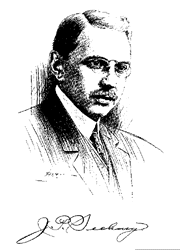
Justis P. Seeburg -- Built the Seeburg company from a modest beginning in 1907. At least a part of Seeburg's success was due to their standardization of models and the music rolls which they used. While most other firms changed designs and styles practically every year or two, J. P. Seeburg offered essentially the same models year after year. Seeburg pioneered the use of the style "A" music roll which later became the industry standard and was used by dozens of other firms. The Seeburg style "G" roll was likewise an industry standard. In the 1920s Seeburg secretly operated the Western Electric Piano Co. to provide sales competition to the Seeburg line. |
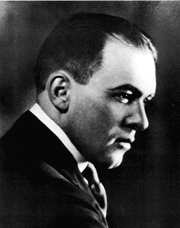
Max Kortlander - The arranger who created and virtually defined the solo piano sound of the 1920s which everyone today recognises as "piano roll style". He joined QRS as a lad and rose quickly to become the chief of the recording department. He purchased the assetts of the company when QRS went bankrupt in 1930 and formed his own firm, Imperial Music Industries, which continued business until the 1970s when it was purchased by Ramsi Tick and incorporated as QRS Music. |
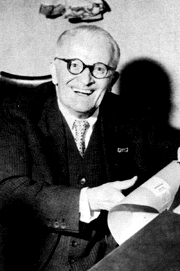
Edwin Welte (1876-1958) and his brother-in-law, Karl Bockish, developed the Welte-Mignon reproducing piano in 1904 for M. Welte & Soehne of Freiburg, Germany. Music roll recording commenced in 1905. The recording piano and the reproducing system were entirely new inventions which astounded the musicians and fans in Europe. In 1906 (?) he established "The Welte Artistic Player Piano Company" in a showroom in New York and soon was producing pianos and music rolls for American customers. |
|
In recent times: 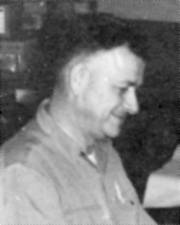
Ed Freyer -- In the early 1960s Ed Freyer, of Flemington, New Jersey, rebuilt a few Link orchestrions and placed them on location. It wasn't long before the old music rolls wore out and became unplayable so he rebuilt an old Acme perforater and made a roll copying machine. His first batch of recuts were of Link rolls provided by collector Murray Clark, then Harvey Roehl convinced Ed to expand to recutting style A and G rolls. This photo by Harvey Roehl was reproduced on page 209 in the book Put Another Nickle In, by Q. David Bowers, ©1966 by The Vestal Press, with the caption: "Ed provides collectors all over the country with quality recuts of A, G and Link rolls." |

Durrell Armstrong (1933-2008) began rebuilding player pianos in 1951, shortly after he graduated from high school. He founded the Player Piano Co. in Wichita, Kansas, to supply hobbyists and professional rebuilders the parts and supplies needed to restore aging pneumatic player pianos and nickelodeons. "I was working at a printing company making 75 cents an hour" he told ABC News. "I found that I could earn $2 an hour repairing player pianos." At its peak in 1973 his business had 31 employees. "I still think of it as an overgrown hobby," he said. |
31 January 1999, 09 November 2005, 31 December 2008, 04 January 2009