courtesy Keith Pritchett, Mansfield, England
The text following is reproduced from a 1920s book about player pianos,
in a chapter about player piano manufacturers.
|
What to play and how to preserve it and make adjustments when necessary", by D. Miller Wilson The Pistonola. This instrument is manufactured by Boyd Ltd., London. The action is all metal and works with a tension twenty-five times greater than that usually employed in pneumatic players. The action can be installed into a piano of ordinary dimensions. Instead of bellows, self lubricating pistons are used, fitted in a single row of metal cylinders. The pistons are made of a special composition of graphite, compressed and moulded with a glass-like surface, and work silently. The air chambers are so small that a metal block 4.75 inches by 1.5 inches contains nine complete striking pneumatics. The device for accenting melody notes is called the modulist, and is controlled from marginal perforations in the music roll. There is also a device called the crescodant by means of which crescendos and diminuendos are obtained. The following explains the modus operandi of the pistonola action. When a perforation in the music roll opens the duct in tracker bar, air passes down the tracker tube and up under the plunger situated in the front part of valve block, the air then lifts plunger, this in turn lifts a small cone valve (called primary) off its seating, the air then passes down by the stem of the valve at the back of valve block; this valve consisting of washer discs, plunger and ball is called the secondary valve. The air lifts ball off its seating by means of washer and plunger up to top of the seat, thereby shutting off the ball chamber from the atmosphere; this chamber is in communication with the cylinder by means of a hole in the side, another hole leading from this at right angles direct into cylinder, the air space above the piston in cylinder is now in direct communication with the main air supply by means of opening under ball seat, the air in space above piston is now drawn out by suction of the pumps, causing the atmosphere on the outside to push the piston up, lifting the whippen by the connecting cord. Normally the air in space above piston is in communication by means of the seat opening above ball. While a note is being played there is a partial vacuum above the piston, but as soon as a hole in the tracker bar is shut off by the music roll the valve falls back and the air from the atmosphere passes back through top seat, opening the ball chamber and then into cylinder, the piston then falls into normal position. |
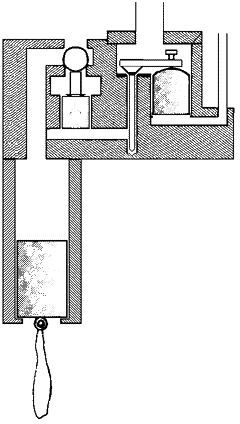 The primary valve (right) is supplied with tension from the roll motor regulator. Feeder tension from the reservoir is applied to the rectangular chamber above the secondary valve piston (left). |
26 February 2000