by Richard Vance (MMD 000228)
| I agree with Craig Brougher that the Pistonola is a terribly unsatisfactory
design, but there is more to it than meets the eye. The printed description
quoted by Mr. Pritchett is flawed in some respects, which might be expected
in a general book about player pianos, rather than the Pistonola manual
itself.
First of all, the statement that the 'tension' is 25 times greater than in an ordinary player must be in error. I calculated the force-area ratios between the Pistonola and an ordinary player, not forgetting that a pneumatic's force is area x pressure x 1/2 due to the hinged end, while a piston' force is simply area x pressure. The result was a factor of about 11, or 132 inches water column (inWC) in the Pistonola, equivalent to 12 inWC in an ordinary player. But the area of the feeder pistons is proportionally much smaller; if the feeder pistons are 3" in diameter, the pedal force ends up nearly the same as for a conventional feeder, about 35 pounds for the 12 inWC example. |
 |
|
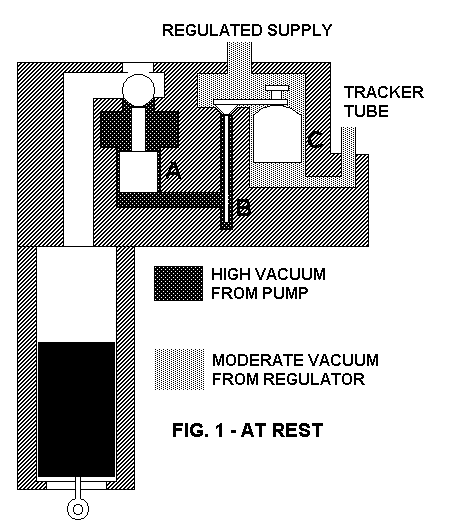
Also, the chapter is not very clear about how the thing actually works. It seems to me to be actually fluidically rather sophisticated. I don't think there are any bleeds at all. There are two small pistons, which I will call the 'pouch piston', connected to the tracker bar, and the 'primary piston', which opens the main player valve. The clue is the statement that these pistons are not graphite composition, which would seal to their cylinders, but brass turnings. They are machined just a bit smaller than the cylinders, and the small clearance would form a relatively long laminar flow path of relatively small capacity, serving the same purpose as a conventional bleed. There are two such 'bleeds', which seem to work as follows. The space above the 'pouch piston' is fed with a much reduced vacuum from the roll motor regulator. This prevents the very high main vacuum from clamping the paper to the tracker bar. When no hole in the roll is present, the leak around this piston (C) keeps the tracker tube evacuated. If a hole appears, its capacity is much greater than the leak, and atmospheric pressure lifts the 'pouch piston' and opens the cone valve. Thus this leak serves the same purpose as the bleed in an ordinary player. |
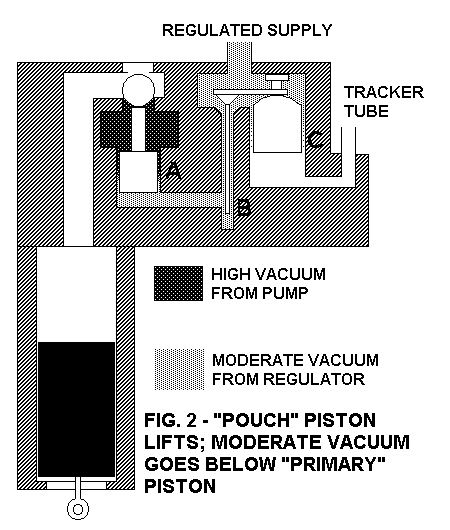 |
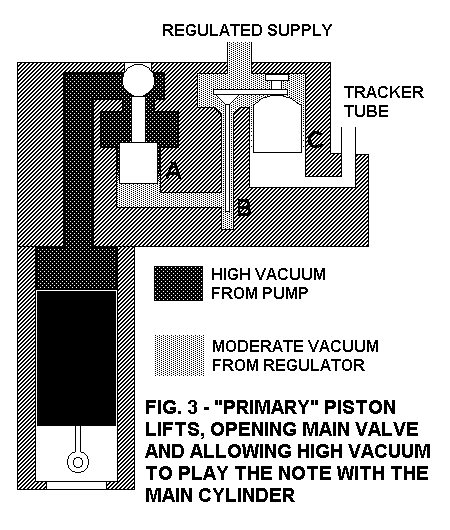
| The 'primary piston' also has a small clearance leak (A) which normally
keeps the main vacuum on both ends of this piston. But when the cone
valve lifts, the capacity around its stem (B) is much larger, so the pressure
under the 'primary piston' rises, not to atmospheric, but to the higher
regulated pressure. This differential pressure is sufficient to lift
the main ball valve and evacuate the note playing cylinder.
The flow through this second 'bleed' is not wasted; it just joins the flow to the roll motor, causing the roll vacuum regulator to open just a bit less. This concept is shown more clearly on some schematic pictures I made. Richard Vance
|
 |
29 February 2000