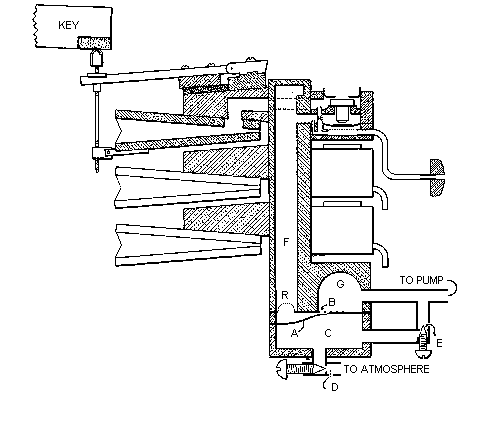
A perforated partition or grid B forms a seat for the rubber cloth pouch A which controls the flow of air from the windchest F to the chamber G, and thence to the pump.
The chamber C under the pouch is connected to pump suction through the adjustable opening E and to atmosphere through the variable opening D.
If E were open and D tightly closed, pump suction through E would pull the pouch completely away from the grid and full pump suction would be admitted to the wind chest F.
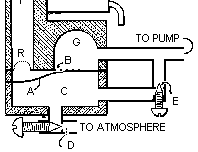 If these adjustments were reversed with E tightly closed and D
open, pump suction in chamber G would cause the pouch A to
seal the holes in the grid and no suction would be developed in the wind
chest F. Without changing the pump pressure, adjusting
the openings E and D between these extremes will produce
a suction in the chamber C which is a fractional part of that developed
by the pump, and this fractional suction will peel the pouch away from
the grid until there is developed in the wind chest the same degree of
suction that exists in chamber C.
If these adjustments were reversed with E tightly closed and D
open, pump suction in chamber G would cause the pouch A to
seal the holes in the grid and no suction would be developed in the wind
chest F. Without changing the pump pressure, adjusting
the openings E and D between these extremes will produce
a suction in the chamber C which is a fractional part of that developed
by the pump, and this fractional suction will peel the pouch away from
the grid until there is developed in the wind chest the same degree of
suction that exists in chamber C.
The pouch will then be in balance and any change of suction in the chest F, due to the playing of notes, etc., will be instantly rectified by a movement of the pouch A.
Any increase in pump suction will give a corresponding fractional increase in suction in the chamber C. This is used in producing amplification and crescendo effects.
The opening E is adjusted at the factory to fit the scale of intensities to the particular pump into which the Ampico is installed. The opening E can also be adjusted to even up the No. 1 intensity pressures, Bass and Treble.
The size of opening D is variable and is automatically controlled from the note sheet.
Reproduced from page 8 and 9,
The Ampico Service Manual 1929,
Copyright 1929 by American Piano Company