|
high-resolution image news1.tif (62 kb LZW compression)
|
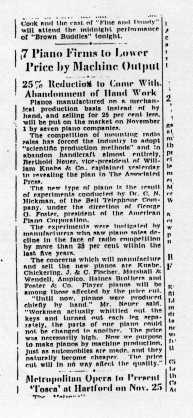 7
Piano Firms to Lower Price by Machine Output
7
Piano Firms to Lower Price by Machine Output
|
high-resolution image news2.tif (77 kb LZW compression)
|
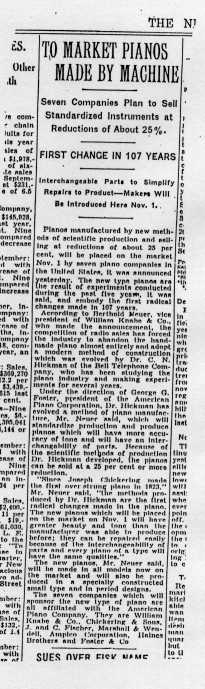 TO
MARKET PIANOS MADE BY MACHINE
TO
MARKET PIANOS MADE BY MACHINE
|
high-resolution image news3.tif (118 kb LZW compression)
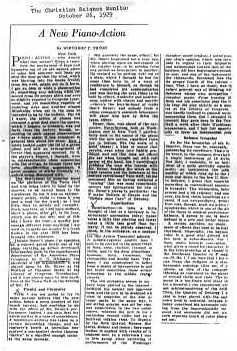
Piano-Action -- who knows what that means? When a tuner took the mechanism of keys and hammers out of an old square piano of mine last summer and bade me shut the door so that the wind, which was blowing into the house freshly from the west, might not do it harm, I got an idea of what a piano-action is; something very delicate when removed from its proper place and ever so slightly exposed to irregular treatment, and yet something capable of enduring wear and weather almost illimitable when set in the case as intended to be by the builder. For all I know, the action of pianos has changed a good deal since the square, which I happen to treasure, was put forth from the factory, though, according to such casual observations as I have made, it has remained in general idea about the same. Now I lately looked under the lid of a grand piano and saw an arrangement of levers that appeared unusual, a great number of sticks formerly required being dispensed with. The instrument in question stood on the platform of Town Hall and was being taken in hand by the movers, to be carted home to the warehouse. To me, it was an extraordinary object, while to them it was just a load for the truck; so I had little time to satisfy my curiosity. Such, however, as I did have sufficed, since a piano, after all, is its tone, which you do not see; and of this one I knew the tone — a quality just enough different from anything I am used to, to make me wonder if a fresh timbre in the year 1929 has been brought into existence. Harold Bauer's piano I'm speaking of, a concert grand lately out of the shop, carrying an action developed, information goes, in the experimental department of the American Piano Company, by C.N. Hickman, the physicist of the organization. It was played upon by Mr. Bauer at the Festival of Chamber Music at the Library of Congress, Washington, and it was played upon by him again here at the Town Hall on the evening of October 19. Pianist and Carpenter Truly I am not going to try to make anyone believe that the new action, being a mere product of the bench anyway, had anything to do with the effect of Mr. Bauer's performance. Indeed, I am sure that the whole matter is a case of coincidence. A musician's artistry has taken on a certain interesting change, and an engineer's knack at invention has evolved a mechanical device (hoping "device" is a dignified enough term) at the same moment. Not precisely the same, either; for Mr. Bauer impressed me a year ago, when playing upon an instrument of the regular type, to be passing from one period as interpreter to another. He seemed to be getting well out of a state, which I thought he had for some time been in, of a want of confidence in himself, as though he had completed his communication and was leaving the next thing to be said by others. Austerity and positiveness, united with charm and suavity -- there's the four-in-hand of traits that's Bauer; and nobody from a piano company's research laboratory will show him how to drive the team, either. Bauer, then, was ahead of the carpenter. Nevertheless, both at Washington and in New York, I particularly took to the sound of the piano with the new action, equalized from top to bottom, like the scale of a good singer; a kind of sound that carries, even when very lightly produced, and one that does not offend the ear when brought out with full power of the hand. Am I unwittingly praising the man who travels with Mr. Bauer, keeping the wires at the right tension and the hammers at the desired velvetness? Very well; let me commend him as having achieved a "voicing" that was most remarkably correct and appropriate for two of Mr. Bauer's pieces in particular; the F major Ballade of Chopin and the 'Reflets dans L'eau' of Debussy." Equalization Equalization -- to take a little thought of that as a tendency in instrumental expression today; upper notes a little less piercing and lower notes a little less gruff than formerly. It can be plainly observed, I think, in the orchestra, as a conductor like Arturo Toscanini adjusts ... [At this point the photocopy becomes difficult to read and transcribe; there is no further mention of the piano or Bauer.] |
 "A
New Piano-Action"
"A
New Piano-Action"