by Dave Kerr (020730 MMDigest)
 Included
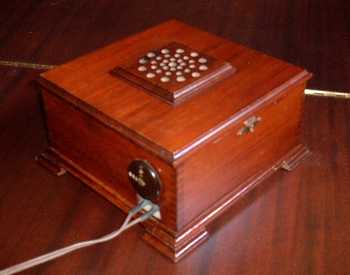
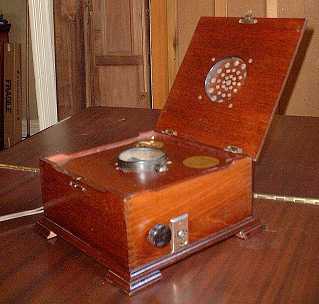
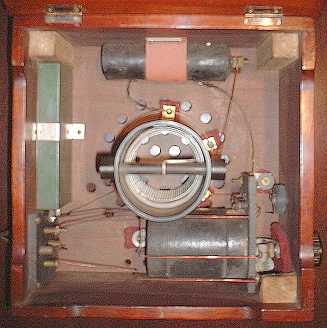
in my modest collection of 'quack' medical machines is a deliciously constructed
early 1920s British-built "Ultrozone". Handcrafted circuitry and
coils are fitted into a fine mahogany case with a power toggle and intensity
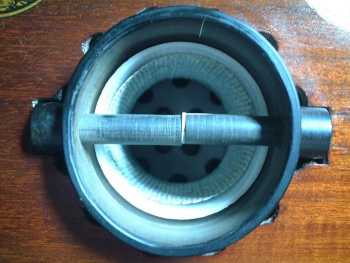
adjustment knob on the side. The central Bakelite cylinder holds
two cylindrical metal grids separated by a milky white glass liner, which
emits a purple glow in the dark. Actually it is so strong you can
see the glow in broad daylight.
Included
in my modest collection of 'quack' medical machines is a deliciously constructed
early 1920s British-built "Ultrozone". Handcrafted circuitry and
coils are fitted into a fine mahogany case with a power toggle and intensity
adjustment knob on the side. The central Bakelite cylinder holds
two cylindrical metal grids separated by a milky white glass liner, which
emits a purple glow in the dark. Actually it is so strong you can
see the glow in broad daylight.
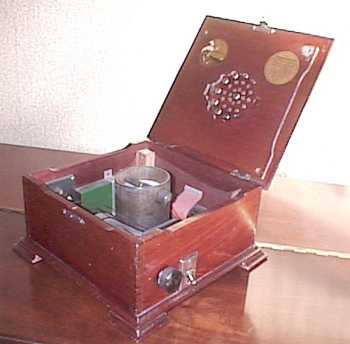
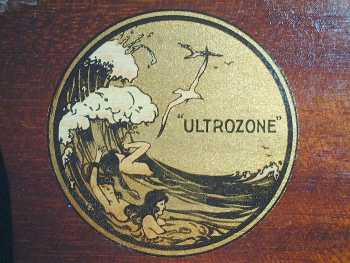
The maker's gold decal sensually illustrates the intended soothing effects, although the intense crackling buzz emanating from the device when in operation would no doubt require the box's placement on the far side of a large room. The Ultrozone pumps out ten times the 'electrical' smell than any post-1980s home ion generator I've experienced.
Michael Woolf wrote [in 020729 MMDigest]: There are probably folks around collecting and restoring antique examples. As for the smell of ozone: think yourself by the ocean -- the air is "bracing." Then consider the atmosphere at Niagara Falls. I believe it has one of the highest concentrations of ions of anywhere in the world, and can rightly be called "highly charged."
Very well put, Michael. Whenever I feel the need of an ozone fix I flip this baby on and think of Niagara Falls. <LOL!> Or I'll pause backstage before our current production of "My Fair Lady" begins and I'll give a hefty crank on Professor Higgins' desktop "Vandergraff Sparker". Whatever it is called, it's that familiar science class static electricity demonstration machine, with the counter-rotating Bakelite disks with radial metal sections.
Personally, I like the odor, but then I also like the smells of zinc organ pipes, gasoline and freshly laid asphalt -- for some reason these smells remind me of childhood. I would be interested to hear from anyone else who has vintage ozone generators.
Dave Kerr
Stratford, Ontario, Canada
30 Jul 2002 14:25:24 -0400
Ed. note: The electrostatic generator with counter-rotating discs is the Wimhurst or Wimshurst machine, first described in 1883 by its inventor, English engineer James Wimshurst. Like many other devices which produce impressive sparks, it was quickly adopted by quack healers and pseudo-science practitioners. Visit Jeff Behary's informative and entertaining "Turn Of The Century Electrotherapy Museum (Prepare to be shocked!)" web site at http://www.electrotherapymuseum.com/Introduction.htm and http://www.electrotherapymuseum.com/index.htm
30 July 2002 Return to MMD Tech site