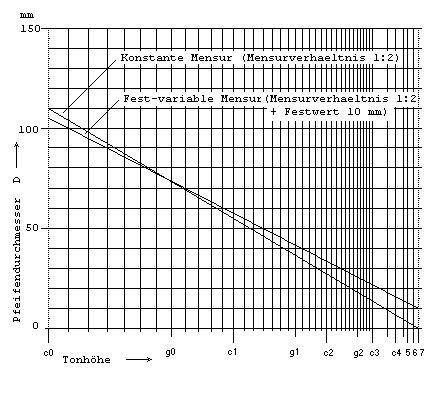
Figure 3.3: Mensur lines. (The normal mensur line represents the diameter of an open pipe in C of 155.5 mm.) For wood pipes D is = D = 2*sqrt(b*t/pi) with b = interior width and t = interior-depth.
Bild 3.3: Mensurlinien. (Die Norm-Mensurlinie gilt für
den Durchmesser einer offenen Pfeife in C von 155,5 mm.) Bei Holzpfeifen
ist D = 2*sqrt(b*t/pi) mit b= Innenbreite und t= Innentiefe.
| 3.2.7.1 The pipes in a register have not only different lengths,
but also different widths. With round pipes this is width of the
interior diameter. With pipes with rectangular profile one can equate
the inner rectangular surface area with a circular surface of the same
circular area. With b as inside pipe-width, t as inside pipe-depth,
then D as inside pipe-diameter is (3.1)
The measure-ratio for the width is the ratio to the width of same-toned pipe in the next deeper octave. Measurements can also be indicated for other dimensions of a pipe, e.g. for the lip width and the cut-up height. The breadth measure regarded here, however, has the greatest importance. When making pipes one thinks of modeling the remaining pipes of the register proportionally smaller or larger in all dimensions; since the length ratio of the octave is 1:2, then the mensur ration would be 1:2. In the case of this calculation, however, it turns out that the tone quality changes over the pipe rank. In the comparison to the bass, the tone becomes ever sharper and leaner toward the treble. Also, this principle does not permit making very small pipess. In Fig. 3.3 this mensur is indicated as constant mensur in the mensur-ratio 1:2 as the broken line. |
3.2.7.1 In einem Register haben die Pfeifen nicht nur unterschiedliche
Längen, sondern auch unterschiedliche Weiten. Bei runden Pfeifen
ist diese Weite der Innendurchmesser. Bei Pfeifen mit rechteckigem
Querschnitt läßt sich über das Gleichsetzen der inneren
Rechteckfläche mit der inneren Kreisfläche ein Ersatzinnen-durchmesser
erhalten. Mit b als innere Pfeifenbreite, t als innere Pfeifentiefe
und D als innerer Pfeifendurchmesser ist (3.1)
Als Mensurverhältnis für die Weite gilt die Weite einer Pfeife in Bezug auf die Weite der tongliechen Pfeife in der nächst tieferen Oktave. Mensuren lassen sich auch für andere Maße einer Pfeife angeben, so z.B. für die Labienbreite und die Aufschnitthöhe. Die größte Bedeutung hat jedoch die hier betrachtete Weitenmensure. Beim Anfertigen von Pfeifen liegt der Gedanke nahe, nach dem Vorbild einer Pfeife die übrigen Pfeifen des Registers in allen Maßen proportional kleiner oder größer zu machen. Da auf Grund der Oktave das Längenverhältnis 1:2 ist, wäre auch das Mensurverhältnis 1:2. Bei dieser Bemessung stellt sich aber heraus, daß sich die Klangfarbe über die Pfeifenreihe ändert. Im Vergleich zum Baß wird der Ton zum Diskant hin immer schärfer und magerer. Auch läßt dieses Prinzip das Anfertigen sehr kleiner Pfeifen nicht mehr zu. In Bild 3.3 ist diese Mensur als konstante Mensur im Mensurverhältnis 1:2 als gestrichelte Linie angegeben. |