Measuring Intensity of Percussion Instrument Tones
By C. N. Hickman
Research Laboratory, American Piano Company
Journal of the Acoustic Society of America (J.A.S.A),
Vol. 1, No. 1, October 1929, pp. 138-146
[p. 142] A great deal of data was obtained in the Laboratory to
determine the accuracy of reproducing hammer velocity with a constant pressure
in the wind chest of an Ampico. It was found that the hammer velocity
could be reproduced with an accuracy of better than five parts in one thousand
in playing a single note.
...
[page 143] Curve #1 shows the velociity of a bass and treble
hammer respectively for various 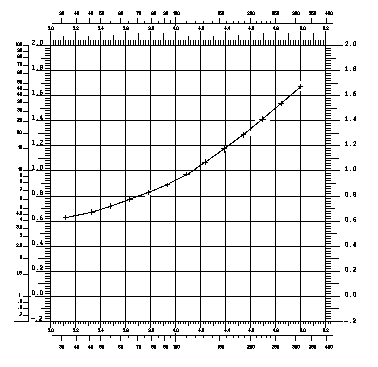 Ampico
wind chest pressures. The dots on each curve represent the Ampico
steps of intensity. The velocity of the hammer and also the wind
chest pressure for each of these intensities may be read from the graph.
The velocity of the treble hammer is appreciably higher than the velocity
of the bass hammer, however, the mass of the bass hammer is greater, so
that the energy remains approximately the same. It is the intention
of piano builders to keep the loudness of the bass and treble portion of
the piano well balanced.
Ampico
wind chest pressures. The dots on each curve represent the Ampico
steps of intensity. The velocity of the hammer and also the wind
chest pressure for each of these intensities may be read from the graph.
The velocity of the treble hammer is appreciably higher than the velocity
of the bass hammer, however, the mass of the bass hammer is greater, so
that the energy remains approximately the same. It is the intention
of piano builders to keep the loudness of the bass and treble portion of
the piano well balanced.
Curve #2 shows the steps of intensity of the Ampico plotted against the logarithm of the square of the hammer velocity. Here it is seen that the slopes of the curves for the two hammers are almost identical. The increase in energy can be determined directly from the logarithms and shows that in each hammer there is an increase in loudness corresponding to 18.2 decibels.
Curve #3 shows Ampico steps of intensity plotted against sensation units or decibels. The only assumption that is made here is that the sensation level for the lowest Ampico step for a single note is 30 decibels (Sensation units). The loudest Ampico step brings the intensity level up to 48.2 decibels. This curve represents the values for both bass and treble hammers. This is on the assumption that the intensity level in each hammer starts at 30 decibels. This is an arbitrary value but the value is the same for both hammers because the Ampico, before leaving the factory is adjusted so that, for the lowest intensity, equal degrees of loudness are obtained from all notes. The value of 30 decibels is arbitrary, being chosen according to the best judgment available.
[page 145] While this intensity range of 18 decibels may seem small, it should be remembered that this range is for a single note. When an artist playing fortissimo and using the sustaining pedal, it is possible to build up an intensity perhaps twenty times as great, which would add and intensity of about 13 more decibels to the range of the piano, giving a total of about 31 decibels.
It has been shown that the velocity of a bass hammer is less than the velocity of a treble hammer for the same level of loudness. this change in hammer velocity is not an abrupt one but takes place gradually from one end of the piano to the other. This is to be expected since the hammers are all different in size. they are moulded in a tapering form and then later sawn apart.
In order to avoid the necessity of using a different measuring scale for each hammer, the contact distances in the bass portion of the recording piano are made smaller than those in the treble. Each hammer has a different contact distance. The total variation from note #1 to note #88 is about .030 of an inch. This gives approximately .0003 inch difference in contact distance for adjacent notes.
Images, TIFF-Huffman encoding:
jasa0.tif 63 Kb
jasa1.tif 78 Kb
jasa2.tif 73 Kb
jasa3.tif 104 Kb
jasa4.tif 54 Kb
jasa5.tif 98 Kb
jasa6.tif 71 Kb
jasa7.tif 114 Kb
jasa8.tif 143 Kb
jasa9.tif 147 Kb
07 April 2002