A sustained discussion thread about the musical terms tremolo and vibrato developed in MMDigest in October 1999 [ ref. http://www.mmdigest.com/Archives/KWIC/T/tremolo.html ]. These terms allude to the quavering sound produced by a skilled violinist or vocalist, and also to the "effects" devices which can be applied to modify the sound of a pipe organ or modern electronic organ or synthesizer. In the case when the underlying tone is a sinusoidal waveform, or sinewave, the result of applying tremolo or vibrato modulation is easily described with simple equations and demonstrated with common laboratory equipment such as the audio oscillator and oscilloscope.
Since the terms tremolo and vibrato are not rigorously defined by the musical world, scientists call the effects FM and AM, meaning amplitude modulation and frequency modulation. The underlying unvarying tone is called the carrier frequency, and the modifying frequency is the modulation frequency. These precise terms (and the descriptive equations) come from telephone and radio technology.
A musical instrument that features amplitude modulation (AM) is the Deagan Vibraphone, a sort of marimba with motor-driven rotating shutters that vary the sound amplitude. The steel guitar (or Hawaiian guitar) features frequency modulation (FM) as the player wiggles the heavy steel bar back and forth to vary the speaking length of the vibrating string.
To illustrate what different modulation forms sound like I have fabricated three synthetic auditory demonstration files. They all share these common parameters:
duration: 1 second
carrier frequency: A=440 Hz
modulating frequency: 6 Hz (the tremolo or
vibrato rate)
The basic signal, or carrier, is a pure sinusoid, so that the samples are devoid of any timbral character that would associate them with any real instrument. Instead, they are intended to point at the specific character evoked by the tremolo/vibrato or AM/FM in itself. The figures below show the power spectrum (energy versus frequency) and the waveform envelope as would be seen on an oscilloscope (amplitude versus time).
Click on the underlined WAV-file name and the browser should launch
a system program at your computer which will play the 1-second sound via
the computers sound card and loudspeaker.
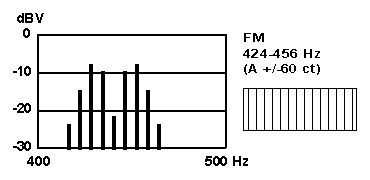 FM.wav
has a pure frequency modulation with an extent (modulation swing) of +/-60
cents, roughly 2/3 of a semitone, meaning that the frequency undulates
between 424 and 456 Hz. Such values would be typical for classical Western
style singing. The spectrum comes out fairly complex as a cluster of partial
tones, centered at the nominal 440 Hz and spaced apart with the modulation/
rate. The amplitude is constant. In a practical situation this kind of
signal will also acquire some amplitude modulation due to resonance effects
in the instrument and the surrounding room.
FM.wav
has a pure frequency modulation with an extent (modulation swing) of +/-60
cents, roughly 2/3 of a semitone, meaning that the frequency undulates
between 424 and 456 Hz. Such values would be typical for classical Western
style singing. The spectrum comes out fairly complex as a cluster of partial
tones, centered at the nominal 440 Hz and spaced apart with the modulation/
rate. The amplitude is constant. In a practical situation this kind of
signal will also acquire some amplitude modulation due to resonance effects
in the instrument and the surrounding room.
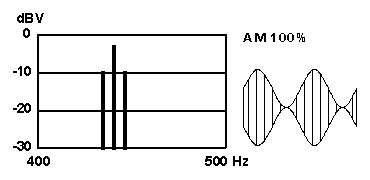 AM.wav
has a pure 100% amplitude modulation. The spectrum has three partial tones,
in radio terminology called the carrier and its two sidebands.
AM.wav
has a pure 100% amplitude modulation. The spectrum has three partial tones,
in radio terminology called the carrier and its two sidebands.
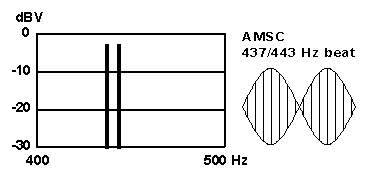 AMSC.wav
is a beat between two tones, 6 Hz apart. This alludes to the technique
used in some organ stops like Voix Celeste where the tone is given by two
slightly differently tuned pipes. In radio this corresponds to AM with
suppressed carrier (AMSC), although with only 3 Hz modulation rate.
AMSC.wav
is a beat between two tones, 6 Hz apart. This alludes to the technique
used in some organ stops like Voix Celeste where the tone is given by two
slightly differently tuned pipes. In radio this corresponds to AM with
suppressed carrier (AMSC), although with only 3 Hz modulation rate.
Equations:
t is seconds, pi =3.1416, f0=440 Hz, fm= 6 Hz
AM.wav: A(t) = sin(2*pi*fm*t)* sin(2*pi*f0*t), where fm= 6 Hz
FM.wav: A(t) = sin(2*pi*f*t) , where f = (f0+k*sin(2*pi*fm*t)) and k=0.036 (modulation index)
AMSC.wav: A(t) = sin(2*pi*f1*t) + sin(2*pi*f2*t) , where f1=437Hz and f2=443 Hz
Wed, 20 Oct. 1999 01:50:33 +0100