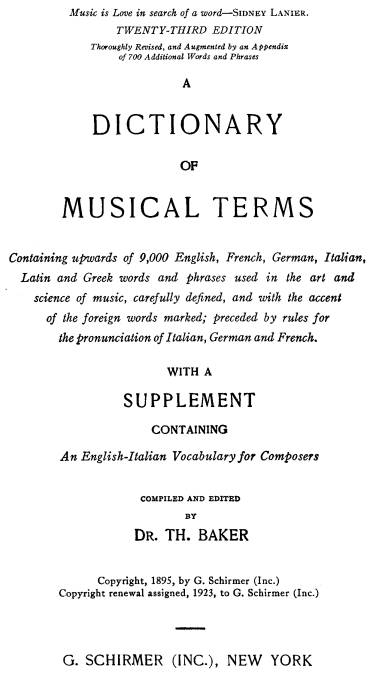
A Dictionary of Musical Terms
Compiled and Edited by Dr. Th. Baker
© 1895 by G. Schirmer (Inc.)
Harmonium. Comp. Reed-Organ.
| [En] Reed. (Ger. Rohrblatt, Zunge; Fr. anche; It. ancia, lingua) A thin strip of cane, wood, or metal, so adjusted before an aperture as nearly to close it, fixed at one end, and set by an air-current in vibration, which it communicates either to an enclosed column of air (organ-pipe, oboe, etc.), or directly to the free atmosphere, thus producing a musical tone. | [NL] Tong. | [DE] Zunge.
{Ein dünner Streifen von Spazierstock (z.B., Calamus), Holz, oder Metall, ...} |
| There are 2 classes of reeds, (1) Free Reeds, which vibrate within the aperture without striking the edges; and (2) Beating (or striking, or percussion) Reeds, which strike on the edges ; in either class, the elasticity of the reed causes its return-stroke after it is borne down by the air-current. | Er zijn 2 soorten tongen: (1) Doorslaande tongen, die trillen binnen de randen van de opening zonder deze te raken; en (2) Opslaande tongen, die groter zijn dan de opening van de lepel en deze afsluiten. | {Es gibt 2 Einteilungen von Zungen: ...}
(1) durchschlagender Zungen ... (2) aufschlagender () Zungen ... |
| Double Reed, two beating reeds which strike against each other (oboe, bassoon). (Also compare Pipe 2, b. Reed-organ, Regal) | gegenschlagender Zunge ... Doppelrohrblattinstrumente |
Reed-instrument. One whose tone is produced by the vibration of a reed in the mouthpiece; the orchestral instruments of the oboe and clarinet groups.
Reed-organ. The precursor of the reed-organs now in use was the Regal, which contained beating reeds similar to those in the reed-pipes of church-organs.
The present reed-organs have free reeds; there are 2 principal classes:
(1) The Harmonium, the bellows of which forces compressed wind outwards
through the reeds ; and (2) the American organ,
in which an exhaust
or suction-bellows draws the air in through them. Until the invention of
the Vocalion, a variety of reed-organ having compression-bellows
like those of the harmonium, the tone of the second class was generally
superior to that of the first.
The wind-supply is ordinarily obtained by the aid of a pair of treadles
operated by the performer. There may be one or many sets of reeds
or vibrators, each controlled by a stop and slider-mechanism. The timbre
of the various orchestral instruments is now very successfully imitated.
Common mechanical devices are the percussion-stop, expression-stop
(harmonium),
knee-swell
(American
organ), tremulant, double-touche,
and
prolongement.
The first reed-organ was invented by Grénié in 1810,
and named by him orgue expressif on account of the crescendo
and
decrescendo
obtainable
on it ; other inventors constructed the æoline, æolodikon,
physharmonica, etc.; the Harmonium,
the first instrument of
the class having several stops, was patented in Paris by A. Debain in 1843.
Reed-pipe, Reed-stop. See Pipe 2, b.
Reed-work. See Stop (noun) 2.
Reel. A lively dance, probably of Celtic origin, still in vogue in Scotland and Ireland, and usually in 4-4 (sometimes in 6-4) time,with reprises of 8 measures; danced by 2 couples.
Refrain. A burden.
Regal. (Ger. Regal) l. An obsolete kind of portable
organ with one or two sets of reed-pipes (beating reeds), a keyboard for
the right hand, and a bellows worked by the left. According to the number
of pipes sounded by each digital, it was called a single or double
regal. The old English name was regall, or a pair of
regalls. (See Harmonium.) A Bibelregal (Ger.) was
one folding up like a large bible ; a bible-organ.
2. (Ger.) An obsolete suffix distinguishing reed-stops; e.g. Harfenregal,
Geigenregal.
3. An old species of xylophone.
Regel (Ger.) A rule.
Regens chori (Lat.) Choir-master
Regierwerk (Ger.) In the organ, the mechanism of the keys and draw-stops, taken collectively.
Register. 1. (Ger. Register.) A set of pipes or reeds controlled
by one draw-stop ; in this sense synonymous with stop (organ-stop).
2. A board with perforations for guiding and steadying the trackers
of an organ-action.
3. A portion of the range and compass of the voice, and of certain
instrumnets; (a) see Voice; (b) comp. Chalumeau.
Register (Ger.) Register l and 3.
Registerknopf, stop-knob
Registerstange, stop-lever
Registerzug, draw-stop mechanism
Stumme Register (pl.),
mechanical stops ; tönende Register (pl.), speaking stops.
Registre (Fr.) 1. A stop-knob.
2. Register 3.
Registration. 1. The art of effectively employing and combining the various stops of the organ.2, The combination or combinations of stops employed for any given composition.
Registrieren (Ger.) To registrate or register (see Registration).
Regislrierung, registration.
Règle (Fr.) Rule.
15 April 2002