by Leonardo Perretti
 The
pipes I'm going to describe belong to the only (as far as I know) instrument
of this kind that is arrived to us today. In its time these organs were
very widespread as chamber instruments in the houses of noble families
in Italy and, I believe, in all Europe.
The
pipes I'm going to describe belong to the only (as far as I know) instrument
of this kind that is arrived to us today. In its time these organs were
very widespread as chamber instruments in the houses of noble families
in Italy and, I believe, in all Europe.
The fact that the tube is made with paper is not a sign of poorness; as I'll explain, the paper is treated in such a way that it becomes a very good and strong material for pipe building. The builder of this organ is known as a learned instrument builder, who worked for northern Italy courts and collaborated with high personalities such as Leonardo Da Vinci and others.
The pipes are made of two pieces: the tube and the foot. The tube is built by winding several layers of strong paper around a mandrel having the proper diameter. While winding, the paper is treated with hardening matter. According to antique treatises, the builders used scaling wax to accomplish the task. The scaling wax is known to be the best material to glue the paper. Maybe hide glue was also used by some builders. The tube that is obtained by this method is as strong as wood, with the advantage that it is more amorphous than wood, and so it is less prone to develop cracks.
In this organ, the biggest pipes are 6 foot long; they are still in good state despite their age. In my opinion, this kind of material is perhaps the best for pipes that are intended for instruments that are subject to movements and shocks.
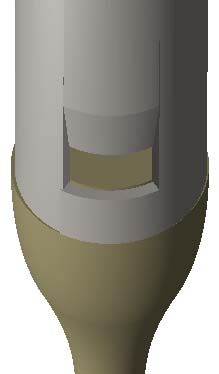
The mouth is engraved in the tube at the proper distance from the bottom edge (see below), and the upper lip is not flattened, but has a semi-circular shape.
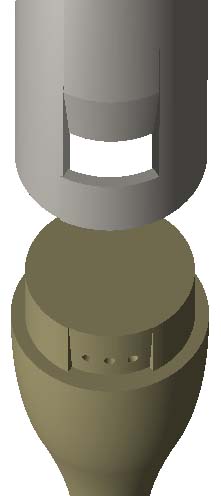
The foot is made of maple wood, and it has the shape that is drawn in the figures; as can be seen, it is worked at the lathe; its upper part is cylindrical and fits to the internal diameter of the bottom of the tube, so that the upper surface of the foot is flush with the lower border of the mouth slot of the tube.
At mouth level, a semi-circular slot is engraved, as in the figure,
so that, when the tube
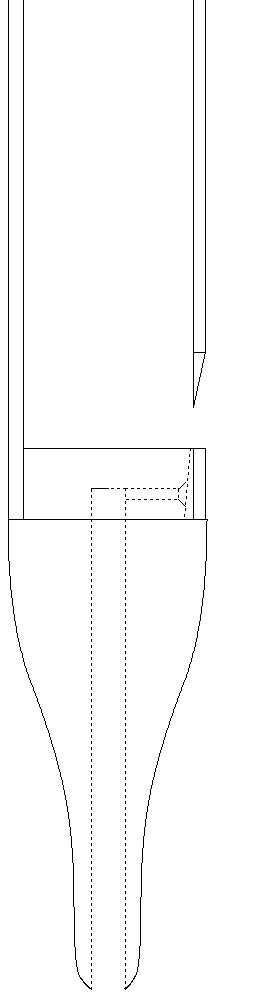
is in place, the flue is formed. The wind coming from the wind chest
goes up in the foot through a vertical hole at its center, which does not
reach the upper edge; it stops at the mouth level, where one to three (according
with pipe's size) radial holes bring the wind to the mouth (see the scheme).
The images show a general front view, a cross section, a detail of the
mouth, and an exploded detail of the mouth. The proportions are not exact,
but very near to the real ones; only the tube is very short, I have cut
the image. These pipes are very narrow in diameter (1/5 to 1/6 for the
biggest). I have a table with the correct measures, if someone is
interested. I have no good photograph to
attach.
I have had no time to try to build some pipes of this kind; if someone will do this, I would like to know the difficulties and the results. According with the antique writers, these pipes should have a soft and pleasant tone, well suitable for house rooms.
Cheers to all
Leonardo Perretti
|
 |
 |
 |
25 April 1999