You are right when you name it "multi-tone" pipe and not "polyphonic".
Sure, they don't play two notes amongst the others at the same time,
as there are three different feet, one for each note.
- The lowest note (C) receives the wind through the first foot.
- The second note (C#) receives the wind by second foot and a wind
conduit feeds the first bellows which opens the first pallet valve.
- The third note (D) receives the wind by third foot and a wind conduit
blows into the second bellows which opens the second pallet valve.
Notice that the first pallet valve opens too, with a connectiong rod...
The notes gathered must be as close as possible as the lonely lip is
cut for three different frequencies (in this instance C, C# and D).
Kind regards from South of France,
Phlippe Crasse
[ https://www.mmdigest.com/Attachments/21/05/31/210531_122848_Debierre_C_C'_D%20(5).jpg
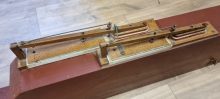 [ Found at https://www.organsparisn.vhhil.nl/beuchet1.htm -- "In 1882,
[ he [Louis Debierre] got a patent for the invention of organ pipes
[ 'of multiple notes'. He named this organ 'orgue portatif à tuyaux
[ polyphones' and sold it around the world."
[
[ In my opinion Debeirre accurately described his invention of
[ "multiple-note organ pipes", but to sell his portable organs he
[ bestowed the fancier (and inaccurate) appellation "polyphonic".
[ Ah, the wonders created by salesmen! -- Robbie
[ Found at https://www.organsparisn.vhhil.nl/beuchet1.htm -- "In 1882,
[ he [Louis Debierre] got a patent for the invention of organ pipes
[ 'of multiple notes'. He named this organ 'orgue portatif à tuyaux
[ polyphones' and sold it around the world."
[
[ In my opinion Debeirre accurately described his invention of
[ "multiple-note organ pipes", but to sell his portable organs he
[ bestowed the fancier (and inaccurate) appellation "polyphonic".
[ Ah, the wonders created by salesmen! -- Robbie
|



.jpg)